
A.C. Gilbert Western Maryland (WM) Steel, Open-top, 2-bay, Offset Hoppers

Model Manufacturer Info
Manufacturer:
A.C. Gilbert
Manufacturer ID:
24225
Prototype Info
Style:
steel, open-top, 2-bay, offset
Year/Era:
1950
Volume:
2073cuft
Road Name:
Atchison Topeka & Santa Fe (ATSF)
Model Info
Gauge:
AF
Introduced:
1960
Road Number(s):
24225
Product Type:
plastic
Finish:
painted & lettered
Wheels:
hi-rail
Couplers:
AF
Online Article:
Supplemental Part:
Supplemental Part:
Supplemental Part:
Supplemental Part:
Notes:
This car was produced up through 1965 in three variations. The first variation, produced only in 1960, has either an orange-red or a red painted body with sintered-iron trucks and knuckle couplers. All of the 1961 through 1965 cars have the Pike-Master trucks and couplers. The second variation has a red plastic body. The third variation is painted red over a black plastic body.
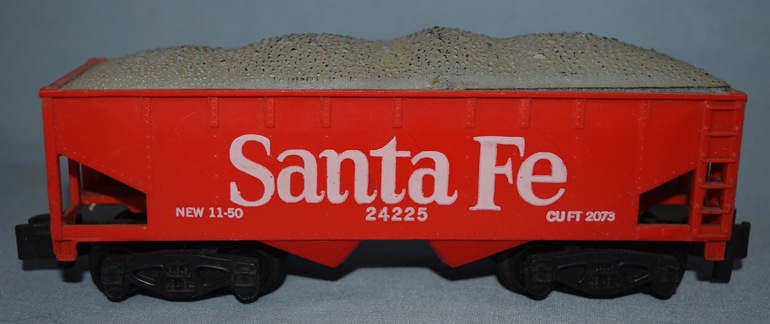
(image copyright © Ted Hamler; used by permission)
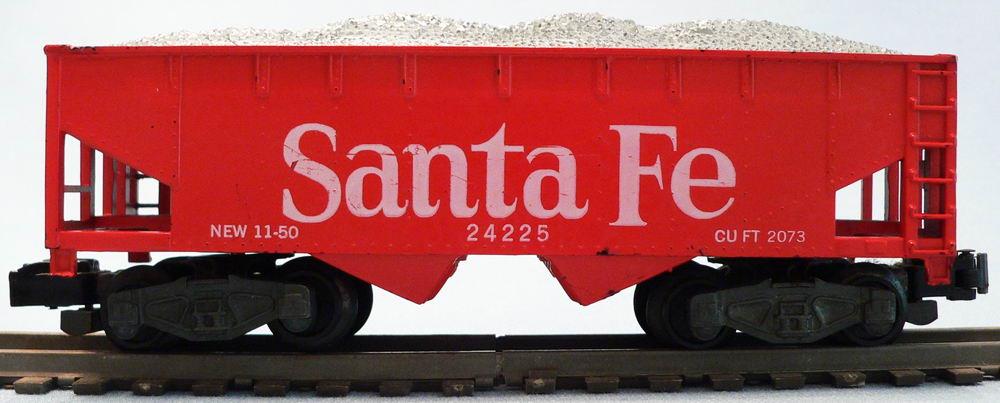
(image copyright © Jim Hammond; used by permission)
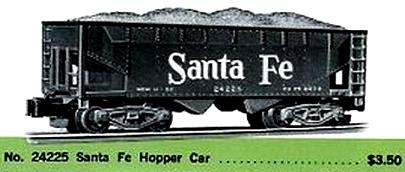
(image copyright © A.C. Gilbert)
Model Manufacturer Info
Manufacturer:
A.C. Gilbert
Manufacturer ID:
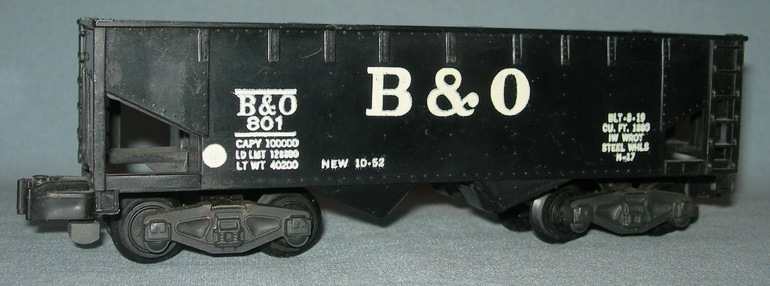
801
Prototype Info
Style:
steel, open-top, 2-bay, offset
Year/Era:
1952
Volume:
1880cuft
Road Name:
Baltimore & Ohio (B&O)
Model Info
Gauge:
AF
Introduced:
1956
Road Number(s):
801
Product Type:
plastic
Finish:
painted & lettered
Wheels:
hi-rail
Couplers:
AF
Online Article:
Supplemental Part:
Supplemental Part:
Supplemental Part:
Supplemental Part:
Notes:
Even though A.C. Gilbert had switched to their 5-digit numbering system, they were still releasing 800- and 900-series cars, which were part of lower-priced train sets, and not sold separately. The #801 came in two variations, namely the common one and the factory-error one which is double-stamped on one side.
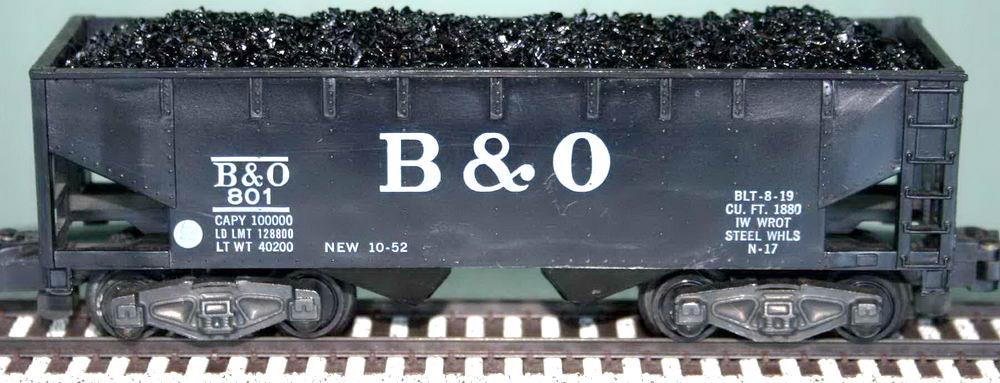
(image copyright © Jim Hammond; used by permission)
(image copyright © Ted Hamler; used by permission)
Model Manufacturer Info
Manufacturer:
A.C. Gilbert
Manufacturer ID:
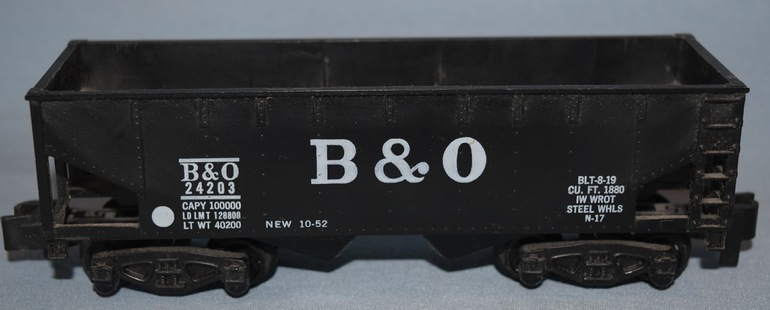
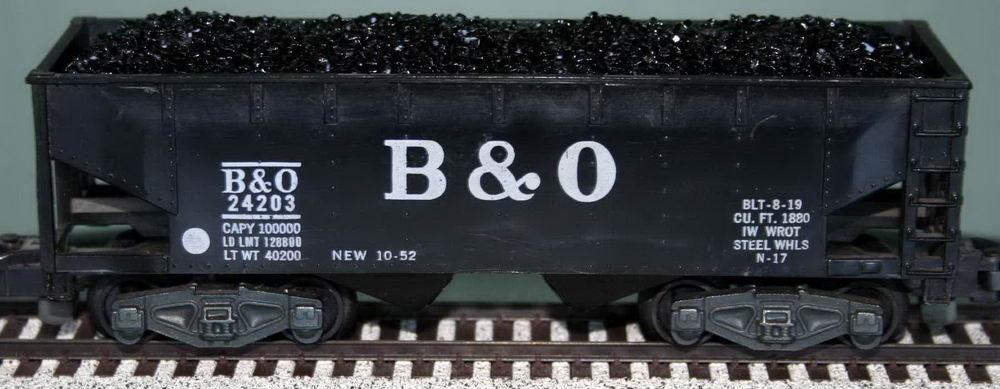
24203
Prototype Info
Style:
steel, open-top, 2-bay, offset
Year/Era:
1919
Volume:
1880cuft
Road Name:
Baltimore & Ohio (B&O)
Model Info
Gauge:
AF
Introduced:
1958
Road Number(s):
24203
Product Type:
plastic
Finish:
painted & lettered
Wheels:
hi-rail
Couplers:
AF
Online Article:
Supplemental Part:
Supplemental Part:
Supplemental Part:
Supplemental Part:
Notes:
The #24203 hopper was produced in 1958, and again in 1963 and 1964, for a total of five variations. Three variations, all with sintered-iron truck and knuckle couplers, were produced in 1958. The first of the 1958 variations has a black plastic body. The second has a glossy black painted body, and the third has a marbleized plastic body because traces of white plastic residue were left in the mold. The two remaining variation, both of which were produced in 1963 and 1964, have Pike-Master trucks and couplers. One of those variations has a dull black plastic body while the other has a shinny plastic body.
(image copyright © Ted Hamler; used by permission)
(image copyright © Jim Hammond; used by permission)
Model Manufacturer Info
Manufacturer:
A.C. Gilbert
Manufacturer ID:
24221
Prototype Info
Style:
steel, open-top, 2-bay, offset
Year/Era:
1945
Road Name:
Chicago & Eastern Illinois (CEI)
Model Info
Gauge:
AF
Introduced:
1959
Road Number(s):
24221
Product Type:
plastic
Finish:
painted & lettered
Wheels:
hi-rail
Couplers:
AF
Magazine Article:
S Gaugian, Sep 2006, pg 33 (history about this car)
Online Article:
Supplemental Part:
Supplemental Part:
Supplemental Part:
Supplemental Part:
Notes:
This car was also produced in 1960.

(image copyright © Jim Hammond; used by permission)

(image copyright © Ted Hamler; used by permission)
Model Manufacturer Info
Manufacturer:
A.C. Gilbert
Manufacturer ID:
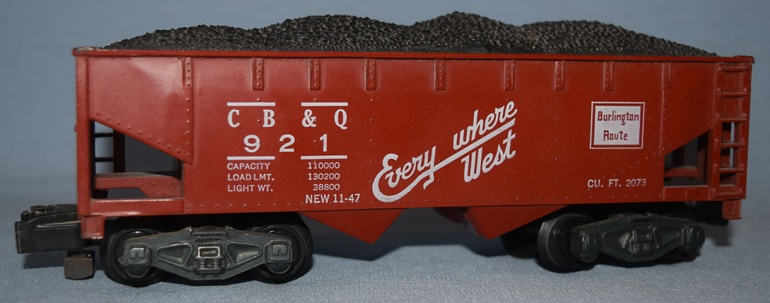
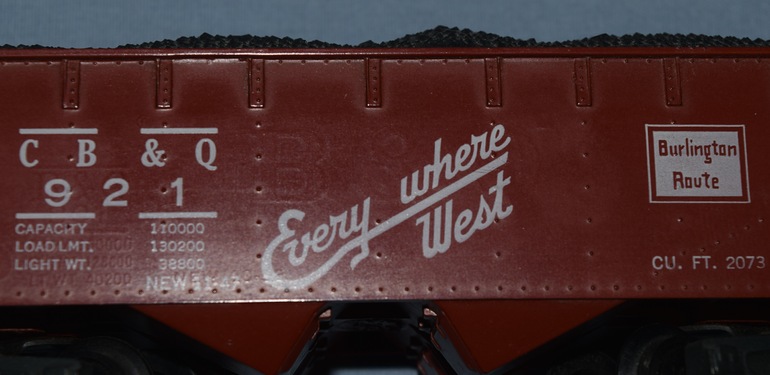
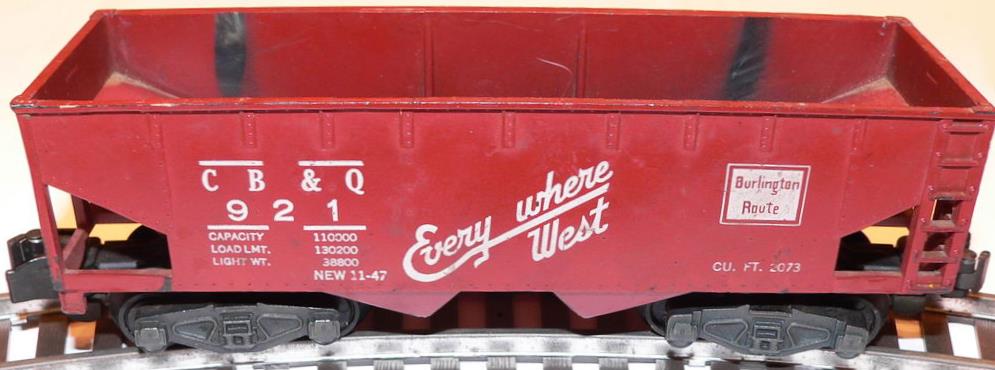
921
Prototype Info
Style:
steel, open-top, 2-bay, offset
Year/Era:
1947
Volume:
2073cuft
Road Name:
Chicago, Burlington & Quincy (CBQ)
Model Info
Gauge:
AF
Introduced:
1953
Road Number(s):
921
Product Type:
plastic
Finish:
painted & lettered
Wheels:
hi-rail
Couplers:
AF
Online Article:
Supplemental Part:
Supplemental Part:
Supplemental Part:
Supplemental Part:
Notes:
Even though A.C. Gilbert had switched to their 5-digit numbering system, they were still releasing 800- and 900-series cars, which were part of lower-priced train sets, and not sold separately. The #921 was produced up through 1956, with two variations. One variation used either black or white molded-color bodies that were then painted a tuscan-red color. The other variation was a tuscan-painted-over #801 with the faint outlines of the B&O lettering being visible on one side only.
(image copyright © Ted Hamler; used by permission)
(image copyright © Ted Hamler; used by permission)
(image copyright © Jim Hammond; used by permission)
Model Manufacturer Info
Manufacturer:
A.C. Gilbert
Manufacturer ID:
24206
Prototype Info
Style:
steel, open-top, 2-bay, offset
Year/Era:
1947
Volume:
2073cuft
Road Name:
Chicago, Burlington & Quincy (CBQ)
Model Info
Gauge:
AF
Introduced:
1958
Road Number(s):
24206
Product Type:
plastic
Finish:
painted & lettered
Wheels:
hi-rail
Couplers:
AF
Supplemental Part:
Supplemental Part:
Supplemental Part:
Supplemental Part:
Notes:
The #24206 hopper was produced in 1958 only in one variation. It is one of the rarest hoppers made by A.C. Gilbert.

(image copyright © Ted Hamler; used by permission)

(image copyright © Jim Hammond; used by permission)
Model Manufacturer Info
Manufacturer:
A.C. Gilbert
Manufacturer ID:
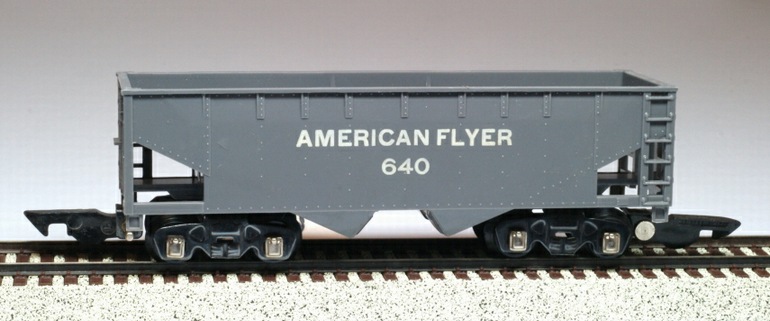
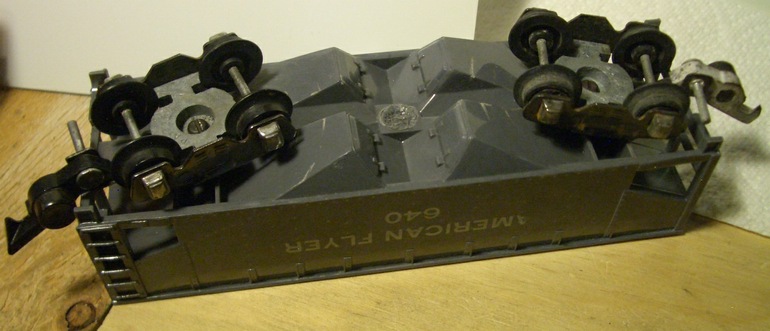
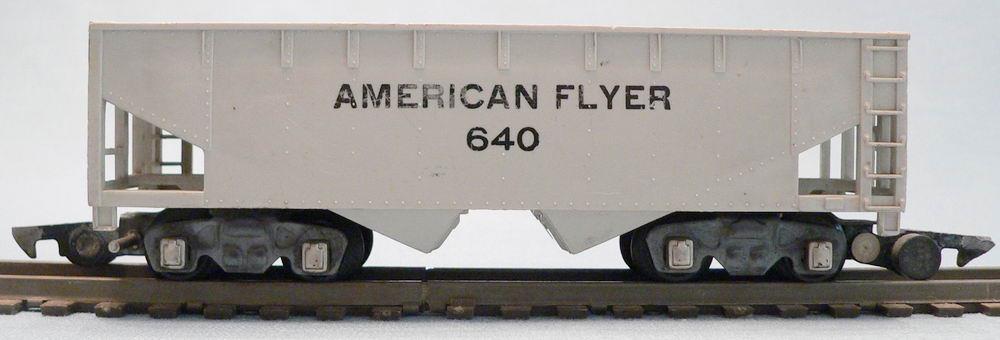
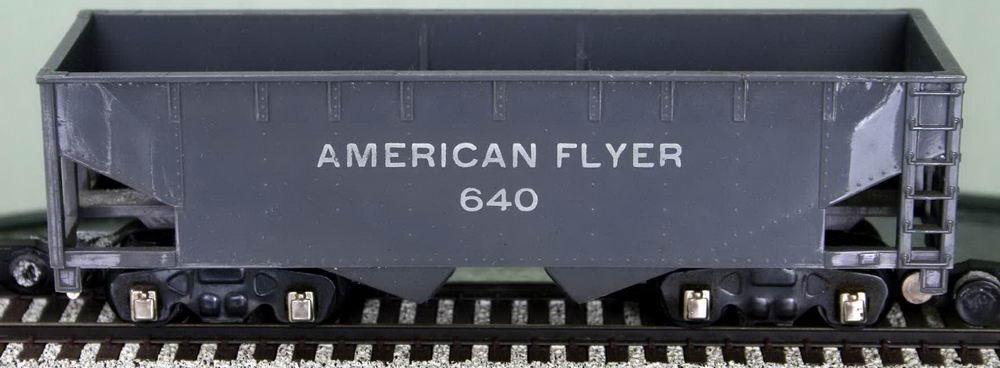
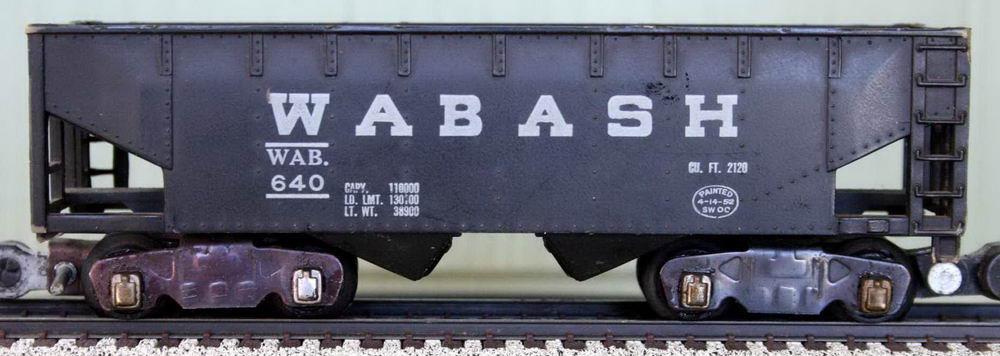
640
Prototype Info
Style:
steel, open-top, 2-bay, offset
Road Name:
fantasy: American Flyer
Model Info
Gauge:
AF
Introduced:
1949
Road Number(s):
640
Product Type:
plastic
Finish:
painted & lettered
Wheels:
hi-rail
Couplers:
AF
Online Article:
Supplemental Part:
Supplemental Part:
Supplemental Part:
Supplemental Part:
Notes:
The car has weights added to the truck. This was standard on the cars with these trucks from 1949 to 1953. This was likely because the cars were too light and/or a bit top-heavy.
(image copyright © Tom Henderson; used by permission)

(image copyright © Carl McAbee; used by permission)
(image copyright © Carl McAbee; used by permission)
(image copyright © Jim Hammond; used by permission)
(image copyright © Jim Hammond; used by permission)
(image copyright © Jim Hammond; used by permission)
Model Manufacturer Info
Manufacturer:
A.C. Gilbert
Manufacturer ID:
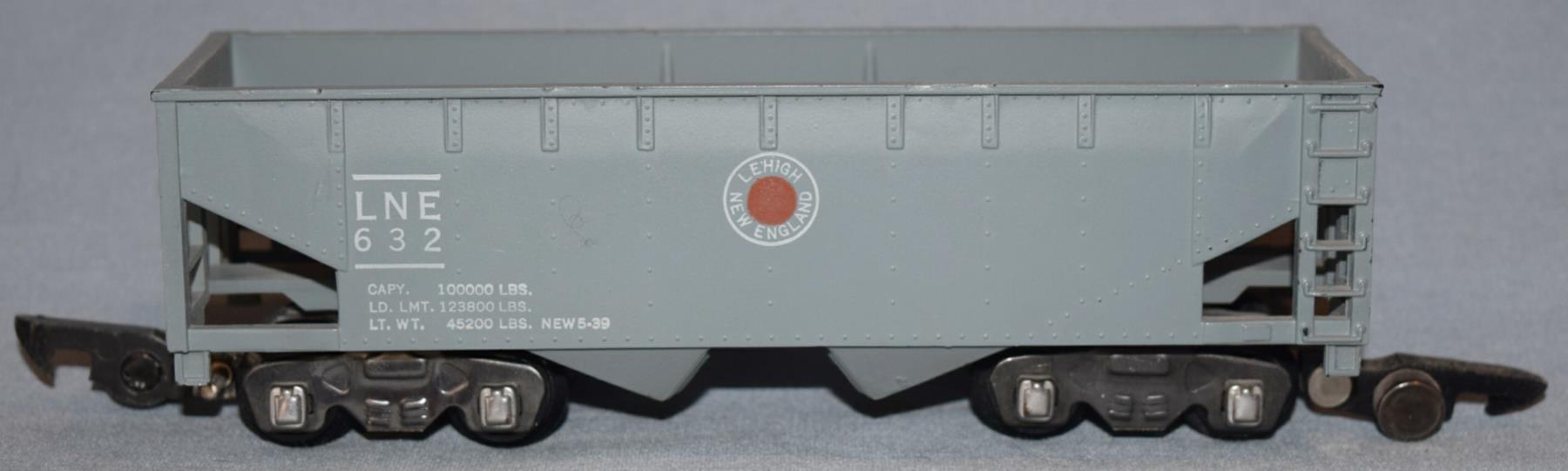
632
Prototype Info
Style:
steel, open-top, 2-bay, offset
Year/Era:
1939
Road Name:
Lehigh & New England (LNE)
Model Info
Gauge:
AF
Introduced:
1946
Road Number(s):
632
Product Type:
plastic or metal
Finish:
painted & lettered
Wheels:
hi-rail
Couplers:
AF
Online Article:
Supplemental Part:
Supplemental Part:
Supplemental Part:
Supplemental Part:
Notes:
There were a large number of variations produced of the #632 car. These were produced up through 1952.
In 1946 the black plastic LNE was produced with either diecast bearing journals or without (as found in lower-priced train sets). One variation had the red dot in the logo and the other did not. The illustration shown in the 1946 catalog shows a gray LNE car, but that variation is actually a bluish-gray and the body is made out of diecast metal. There were also two gray plastic-bodied cars released, one with the red dot and one without, and both had thick shank link couplers. The Virginian car came out in that year as well and has no number printed on it. The light-gray diecast metal car, which has diecast bearing journals was actually a repeat of the 1939-41 catalog #508 and K508 (kit version). This car also has four movable bay doors.
In 1947 a dark-gray plastic body version was released that has thick shank link couplers, and a red dot in the logo.
In 1948 there were two plastic body versions released, with one being light-gray and the other being dark-gray. Both had the red dot in the logo and both used link couplers with a brass weight.
From 1949 through 1952 there were two plastic body versions released, with one being light-gray and the other being dark-gray. Both had the red dot in the logo and both used link couplers.
In general, some cars came with weights on their trucks to help them track better.

(image copyright © Ted Hamler; used by permission)
(image copyright © Ted Hamler; used by permission)

(image copyright © Jim Hammond; used by permission)

(image copyright © Jim Hammond; used by permission)
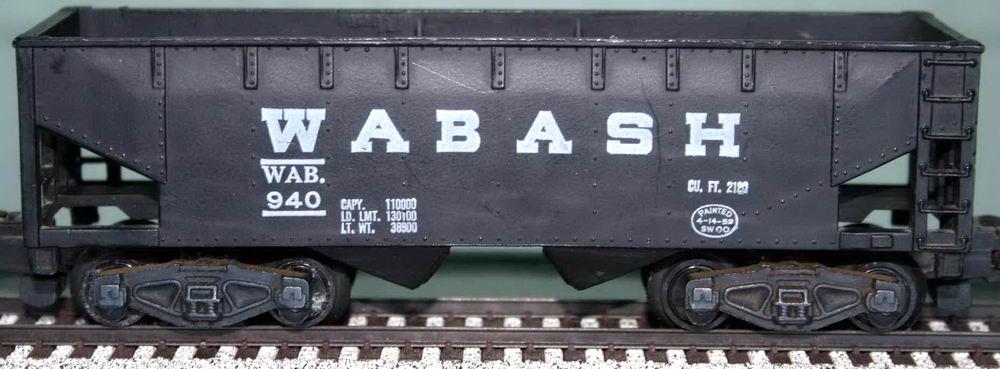
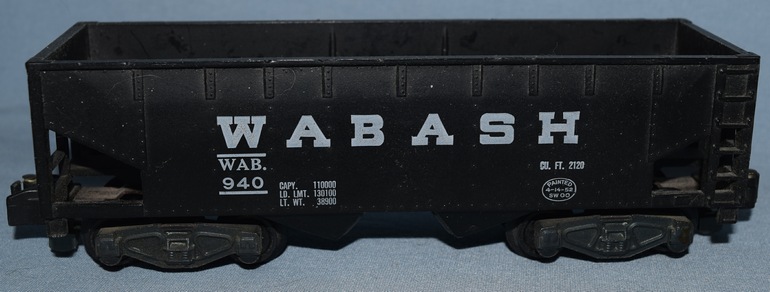
Model Manufacturer Info
Manufacturer:
A.C. Gilbert
Manufacturer ID:
940
Prototype Info
Style:
steel, open-top, 2-bay, offset
Volume:
2120cuft
Road Name:
Wabash (WAB)
Model Info
Gauge:
AF
Introduced:
1953
Road Number(s):
940
Product Type:
plastic
Finish:
painted & lettered
Wheels:
hi-rail
Couplers:
AF
Online Article:
Supplemental Part:
Supplemental Part:
Supplemental Part:
Supplemental Part:
Notes:
Even though A.C. Gilbert had switched to their 5-digit numbering system, they were still releasing 800- and 900-series cars, which were part of lower-priced train sets, and not sold separately. The #940 car was produced up through 1956 in only one variation. The car can have either Type 8 or 9 sintered-iron side frame trucks and knuckle couplers.
(image copyright © Jim Hammond; used by permission)
(image copyright © Ted Hamler; used by permission)
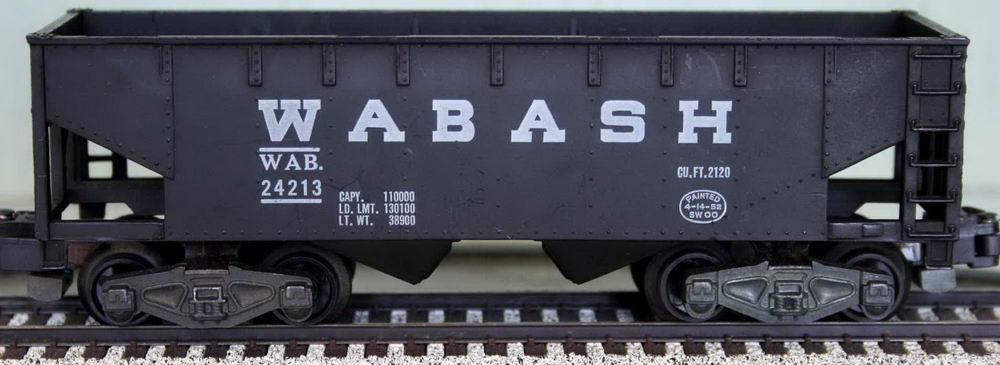
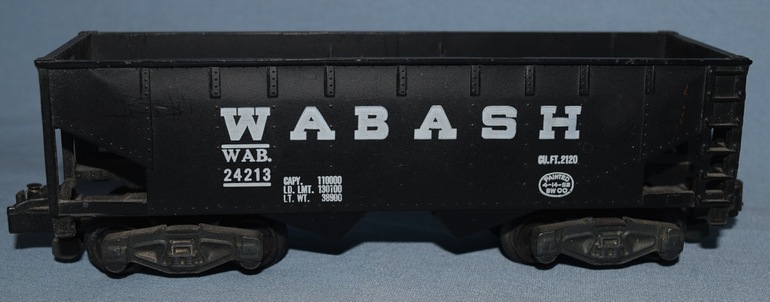
Model Manufacturer Info
Manufacturer:
A.C. Gilbert
Manufacturer ID:
24213
Prototype Info
Style:
steel, open-top, 2-bay, offset
Year/Era:
1952
Volume:
2120cuft
Road Name:
Wabash (WAB)
Model Info
Gauge:
AF
Introduced:
1958
Road Number(s):
24213
Product Type:
plastic
Finish:
painted & lettered
Wheels:
hi-rail
Couplers:
AF
Online Article:
Supplemental Part:
Supplemental Part:
Supplemental Part:
Supplemental Part:
Notes:
The #24213 hopper was produced from 1958 through 1960 in two variations. The first variation has a black plastic body, while the second is painted black over a black plastic body.
(image copyright © Jim Hammond; used by permission)
(image copyright © Ted Hamler; used by permission)
Model Manufacturer Info
Manufacturer:
A.C. Gilbert
Manufacturer ID:
24219
Prototype Info
Style:
steel, open-top, 2-bay, offset
Year/Era:
1953
Road Name:
Western Maryland (WM)
Model Info
Gauge:
AF
Introduced:
1958
Road Number(s):
24219
Product Type:
plastic
Finish:
painted & lettered
Wheels:
hi-rail
Couplers:
AF
Online Article:
Supplemental Part:
Supplemental Part:
Supplemental Part:
Supplemental Part:
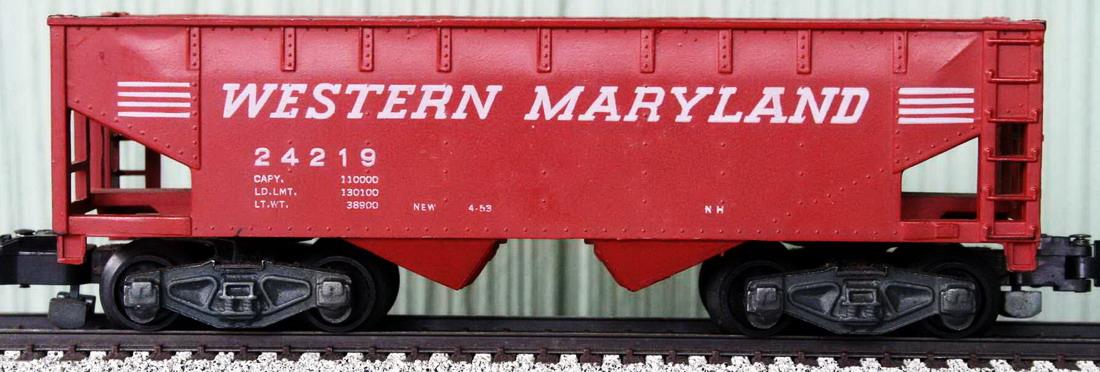
(image copyright © Jim Hammond; used by permission)