
Track Trip Electronics by A.C. Gilbert

Manufacturer:
A.C. Gilbert
Product Type:
track trip
Manufacturer ID:
670
Introduced:
1955
Gauge:
AF
Online Article:
Notes:
The "Track Trip" was also produced in 1956. It clips on to one rail of the track where the rail has been insulated with a fiber pin. This unit could then detect a train's presence by sensing the current draw.
Manufacturer:
A.C. Gilbert
Product Type:
track trip
Manufacturer ID:
695
Introduced:
1946
Gauge:
AF
Online Article:
Online Article:
Notes:
The "Automatic Track Trip" #695 (this product number was re-used for other items in later years) was only produced in 1946 and is exceedingly rare. These were intended to be used for having a locomotive trigger the #587 block signal or the #588 semaphore. Rumor has it that real-world testing proved the track trip to be unreliable, and so they were stopped.

(image copyright © A.C. Gilbert)
Manufacturer:
A.C. Gilbert
Product Type:
track trip
Manufacturer ID:
696
Gauge:
AF
Online Article:
Notes:
This Track Trip responded to the detection of a wheel crossing it, sending voltage to the attached accessory.
Manufacturer:
A.C. Gilbert
Product Type:
track trip
Manufacturer ID:
697
Introduced:
1950
Gauge:
AF
Notes:
Produced through 1954 in only one variation. While it was sold separately, it often came with accessories. It has a raised part on the base that locks onto the rail. When the swivel clip is engaged on the unit, the large circular sheet metal actuating plate with a half-round notch and an eight-point "star" wheel (which is used to adjust the spring tension of the electrical contact) operates the connected accessory.

(image copyright © Ted Hamler; used by permission)
Manufacturer:
A.C. Gilbert
Product Type:
track trip
Manufacturer ID:
26670
Introduced:
1957
Gauge:
AF
Notes:
This was also produced in 1958. It was the 5-digit version of their previous #670 track trip. In 1957 there were still some unsold #670 packages, so they were simply stamped with the new 5-digit number, as can be seen in the example in the photo.
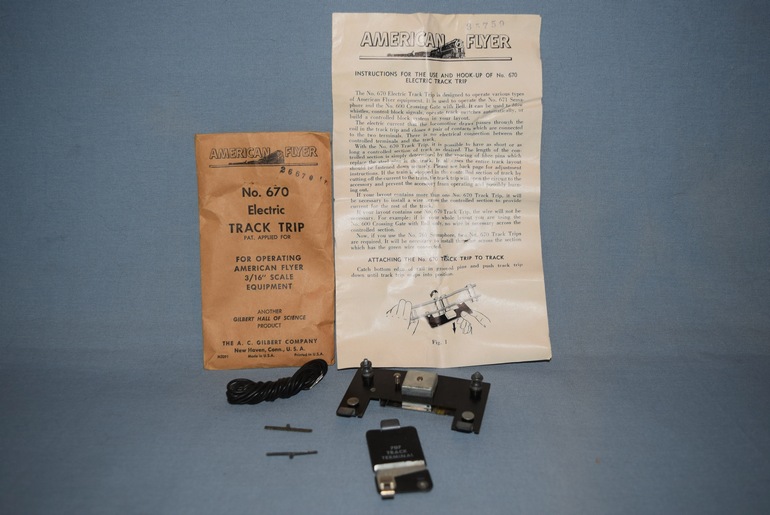
(image copyright © Ted Hamler; used by permission)
Manufacturer:
A.C. Gilbert
Product Type:
track trip
Manufacturer ID:
26671
Introduced:
1959
Gauge:
AF
Online Article:
Online Article:
Notes:
The canister-style "Electric Track Trip" cam in a cardboard box with "26671 Track Trip" printed in black ink on one end. The box contains the following: #26671 Relay, #26690 Track Terminal, two #707 Track Terminals, two #26692 Fiber Pins, two sections of wire, and the M4235 Instruction Sheet.

(image copyright © Ted Hamler; used by permission)
Manufacturer:
A.C. Gilbert
Product Type:
track trip
Manufacturer ID:
26672
Introduced:
1960
Gauge:
AF
Online Article:
Notes:
This "Electric Track Trip" utilized a new relay design unlike the one used for the #26671 Track Trip. The new relay has "26672" embossed on the base of the relay. The rectangular relay comes packaged in a cardboard box that has "26672 Track Trip" printed in black ink on one end. It contains the following: #26672 Relay, #707 Track Terminal, two #26692 Fiber Pins, and the M4895 Instruction Sheet.
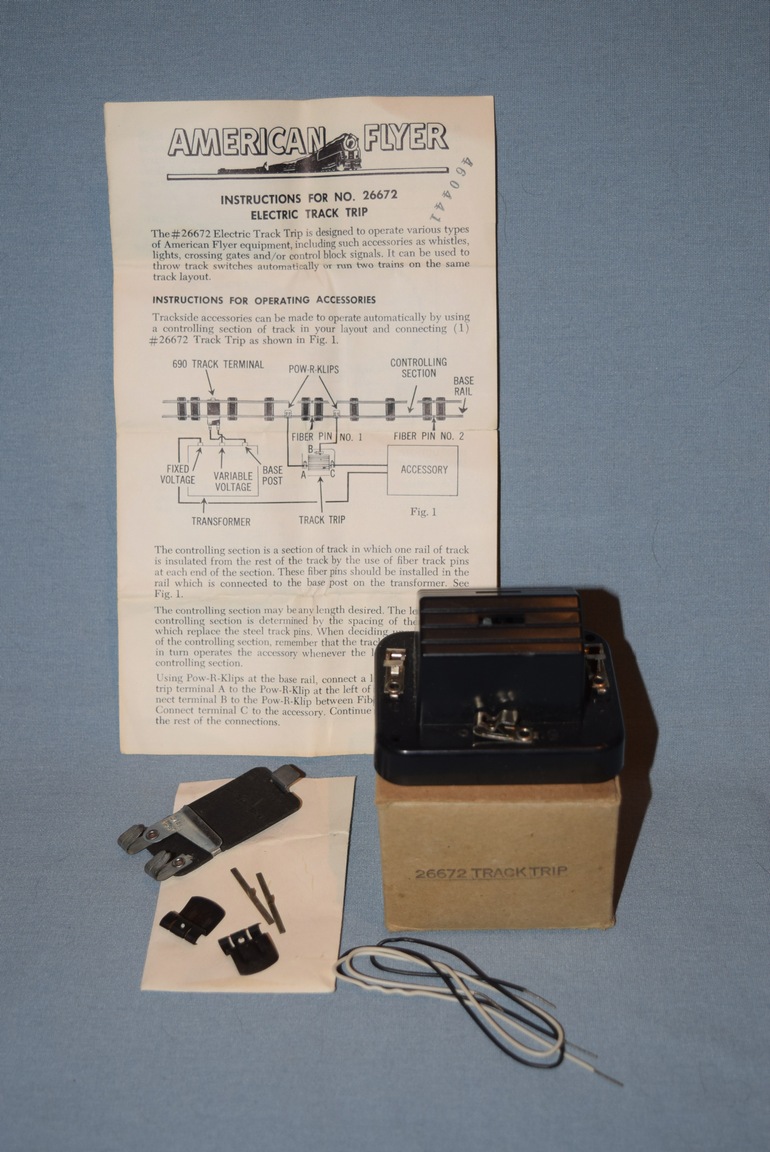
(image copyright © Ted Hamler; used by permission)
Manufacturer:
A.C. Gilbert
Product Type:
track trip
Manufacturer ID:
26673
Introduced:
1961
Gauge:
AF
Online Article:
Notes:
This "Electric Track Trip" was produced through 1964. The basic #26673 trip is identical to #26672, except it was packaged under the new catalog number because it contained parts to allow it to be used with either the older track system or the new Pike-Master track system. The rectangular relay comes packaged in a cardboard box that has "26673 Track Trip" printed in black ink on a white label on one end. It contains the following: #26672 Relay (i.e. the same unit as before), #26690 Track Terminal, two #26692 Fiber Pins, two #26810 Pow-R-Clips, two #26341 Pike-Master Insulating Pins, two #26344 Pike-Master Terminals, and the M5408 Instruction Sheet.
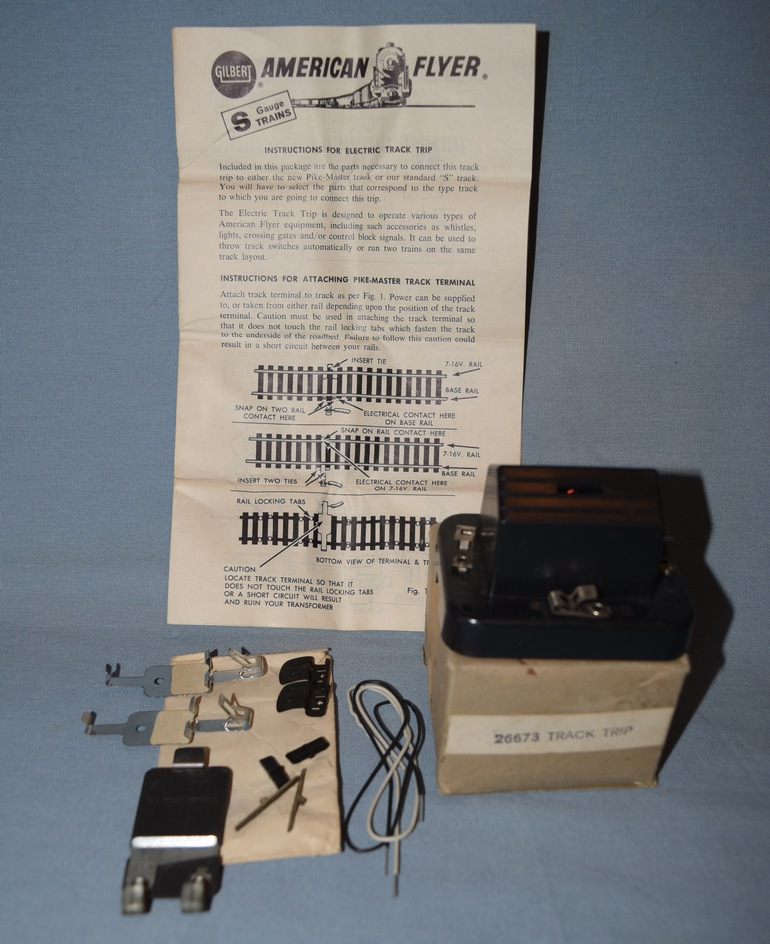
(image copyright © Ted Hamler; used by permission)