
The S Scale SIG
The S Scale Journal
Volume 4 No. 1, February 18, 2015

Gilmaur Etched Brass U18B Diesel Body Kit
By Dick Karnes
The S scalers at February 2015's O Scale West Plus S meet in Santa Clara CA were pleasantly surprised to see the American debut of a new brass kit from the United Kingdom. Mike Calvert was there, off in an O scale corner, displaying the new Gilmaur etched brass kit for an S scale U18B. Mike did the etching drawings; his friend Colin Stewart assembled the pilot model.
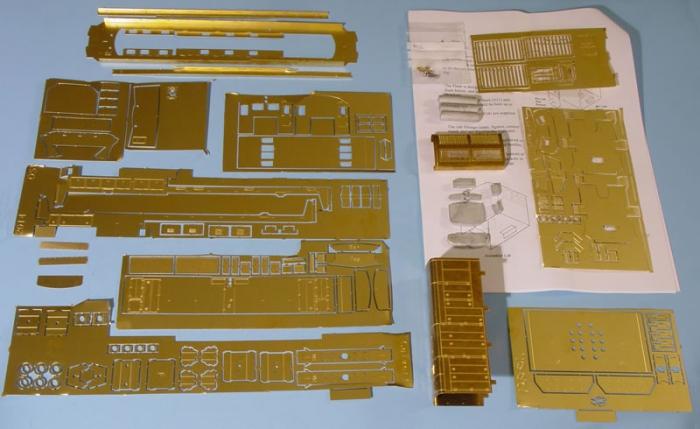
Fig. 1. Here's what's in the kit box. Preformed components include the man frame parts (top left), the radiator grid (right of center), and the rounded portion of the hood (lower right of center). Alternative mounting brackets appear on the bottom left fret. White metal components (right of center) are provided in lieu of etchings which would have been overly complex to design and assemble. All etchings are .015" brass sheet. Mike recommends using ordinary sewing scissors to cut the parts from their frets. (Don't use the wife's. BUY YOUR OWN!) Use your fingers to fold the parts; reverse-etched grooves greatly aid this process. Dick Karnes photo.

Fig. 2. The difficult forming of the hood and radiator grids is done for you back at the factory. The etched grid mesh does not resist denting very well, so be careful during assembly - and transport of the finished model, if that is a factor for you. Dick Karnes photo.

Fig. 3. This front view shows the white-metal headlight and nose-top castings. Note that the brass components are already cored for additional details: windshield wipers, door handles, classification light lenses, coupler lift bar mounts, air hose valve. Bent handrail stanchions are casualties of transport. Handrail wire is not included in the kit. Despite the appearance of what some would consider excess solder, the level of expertise shown here is sufficient to produce a blemish-free model when painted. John Gibson photo.

Fig. 4. This rear view clearly shows the holes for the nose grab irons, already present in the etching so you don't have to do any measuring and drilling. John Gibson photo.

Fig. 5. This side view of Colin Stewart's pilot model shows American Models (AM) power trucks installed. Sideframes are Blombergs, although AM can furnish AAR Type B sideframes for the same power trucks. Note the exhaust stack, nose top, and air tanks, all white-metal castings. This model did not travel well, as evidenced by the bent handrail stanchions. You can stiffen them by coating their backs with solder. Also, if you must transport your model, pieces of 3/8\" Styrofoam inserted between the handrails and the hood will offer protection against distortion. John Gibson photo.
The kit consists of brass etchings, cast white-metal components, an envelope of machine screws and nuts, and a detailed instruction booklet. Detailing parts must be supplied by the modeler, e.g., handrail wire, grab irons, windshield wipers, door handles, coupler lift bars and brackets, and various items specific to the particular prototype road being modeled. Most of these can be obtained from BTS. The modeler also needs to provide a motor, power train, and power trucks and sideframes. Prototype U18B locomotives sported a variety of truck sideframes, but AAR Type B (as on American Models RS-3 trucks) and EMD Blombergs were most common.
The hood, radiator grid, and underframe stiffeners are pre-formed. All other brass parts are flat, reverse-etched with bend grooves for easy, crisp bending to the required angle. Where appropriate, the etchings are designed for slot-and-tab placement of the components (e.g., step treads) for soldering. Handrail stanchions are also included, etched to represent the prototype's U-shaped cross-section. These are particularly fragile; Mike recommends tinning the rears of the stanchions with solder before removing them from the fret in order to provide added stiffness.
Two kinds of motor mounts are provided: One U-shaped set for mounting American Models-type trucks that require a mounting nut high up inside the hood, and another set for under-the-floor power trucks such as Black Beetle and the forthcoming Jim King/NWSL Stanton drive.
You need soldering skills to assemble the model. A soldering iron is the minimum requirement. However, if I were to build this model, I would prefer to use a 140-watt trigger-operated soldering gun for the lighter work such as installation of steps, stanchions, and smaller details.
Retail price: $200 USD (check or PayPal), including shipping.