
The S Scale SIG
The S Scale Journal
Volume 5 No. 1, January 12, 2016

Interior Detail For Your AM Heavyweight Pullmans
By Dick Karnes
Photos by the author
I've had an unlettered American Models/NASG two-tone grey heavyweight Pullman 10-1-2 car sitting idle for several years. Recently I decided to finally get this guy lettered. So I began looking at the car. I also decided to put an interior in this car (and maybe others too), so I bought a few Palace Car Co. (www.palacecarco.com) S scale interior detail kits (Item No. 9702) for 10-1-2 cars. Palace's S scale interior kits arose from an NASG project to bring new products to market. One of the results is these interior kits, as well as ordinary coach seats, that continue to appear in Palace's regular line of products.
There are a few things you need to know before starting this project. The cardstock Palace interior flooring was designed for the American Models (AM) heavyweight Pullman cars, but the rest of the kit is not. (If it had been, it would have been unusable with other brands, like SouthWind brass models.) The cardstock flooring is marked with notches required to clear the glass-positioning prongs inside the AM carbody. The interiors are to be assembled by gluing the components to the car-floor cardstock. If you intend these assemblies to fit brass cars, they drop in without alteration. For the AM cars, although notching the floor for the AM prongs allows these interior assemblies to slip right into the AM carbody, the roof molding will not fit because of the substantial thickness of the window glass. You therefore have two surgical choices - either remove outer portions of every partition and seat, or remove the "glass" portions of the AM roof molding. I chose the latter method.

Fig. 1. For most American Models (AM) Pullmans, the roof comes off easily once each of the screws immediately behind the coupler box is removed. The photo shows this screw just aft (left) of the coupler box. There are no such screws on older AM Pullmans. Instead, several hooked tabs must be poked and prodded to release the roof. These tabs on the more modern AM cars are not hooked. One of these can be seen just slightly left of the top center journal.
The first task is to remove the car's roof. There are two screws, one on each end of the floor just behind the coupler boxes (Figure 1). Removing these releases the roof with its integral clear window "glass." (The first production run of AM Pullmans is different. There are no roof-retention screws. Instead, the locking tabs visible next to the car sides when you turn the car upside down must be poked and prodded to get the one-piece roof and side glass off.)

Fig. 2a. The prongs inside the carbody are there to guide the AM window glass, integral with the roof molding, to slide in snugly next to the sidewalls. You can leave these in, but if you do, you will need to do major surgery on interior partitions and a few seats. My preference is to remove them, requiring surgery on the roof molding instead.

Fig. 2b. Here we have removed the prongs. Neatness doesn't count here because the floor will be covered by the interior kit's printed carpet.
Looking into the carbody, you will see the several glass-positioning prongs along bottom of each side (Figure 2a). Remove them by grabbing them with pliers and twisting back and forth. Any portion of a prong that remains can be removed with a Dremel grinding bit. Figure 2b shows the result. Then cut the entire window glass portions away from the AM roof, leaving the vestibule glass intact as well as a 1/8" flange just beneath the edges of the roof (Figure 3). These flanges are necessary to fit inside the tops of the car sides, thereby maintaining alignment of the reinstalled roof.

Fig. 3. Use a Dremel cut-off disc to remove most of the window material from the roof molding; leave a 1/8" margin at the top. Also leave the clear partitions and door window material intact at the car ends. One of the removed clear panels sits in front of the altered molding.
If you need to letter or stripe the carbody, now is the time to do it, before you install the new window material. Reason: Overspraying with clear flat, highly recommended after applying decals or transfers will cloud the window material.

Fig. 4. New window glass and shades are installed. The "glass" is a 3/4" wide strip of .005" clear styrene; one of these strips is draped over the car. The rest-room prism windows were cut from a Walthers O scale decal set.
After lettering and overspraying, cut strips of clear .005" styrene to replace the AM glass and glue them inside the car (Figure 4). Use liquid plastic cement applied with a No. 0 artist's brush along the edges of the "glass." Capillary action will draw the glue in from the edges.

Fig. 5. Here are the two preassembled 10-1-2 interior components. The black-and-white floors denote the lavatories. There are two of these (one on each end, a ladies' and a men's) for section and compartment occupants; the one toward the center of the car belongs to the occupants of the drawing room. I have not installed toilets and sinks because the prism windows make these restrooms invisible from outside the car. If you choose to have a removable roof, you might want to purchase some S scale toilets (some were for sale at the last NASG National Convention); Walthers HO sinks can be used as well. The rest room anterooms at the car ends will also need seats like the ones in the compartments. This particular interior was constructed to fit around interior prongs. Note the cutouts in the flooring as well as some seat surgery (e.g., the right-hand seat in the drawing room).
Now to the Palace kit. If your car will be illuminated, you should paint your seats, bulkheads, and partitions first. If not illuminated (like mine), leaving the interior components unpainted will make them more visible through the windows. Once assembled, you will have a complete interior consisting of floor, seats, partitions, and bulkheads. If you are doing the 10-1-2 car, there will be two components (Figure 5); the 12-1 interior kit builds up as a single unit. These interior inserts will fit into the carbody without alteration. Slip them in place. You may have to lightly flex the sides apart for them to drop in.

Fig. 6. Here we see the partition notches that had to be cut into each partition in order to clear the 1/8" margin remaining on the roof molding.
However, the tops of the bulkheads will still not fit into the underside of the roof. Using a side-cutting nipper, cut notches in the outer top edges of the partitions, just wide enough to clear the roof flanges (Figure 6). About 1/8" or so wide should be sufficient. Test-fit the roof after you trim the first couple of partitions, then adjust your cuts to suit. Figure 7 shows the unlettered unglazed car with the interior and the roof temporarily set in place. If you like, you can install window shades randomly before reattaching the roof (Figure 4). For this, I used single strips of colored paper cut to suit, then Scotch-taped them in place before screwing the roof in place. Figure 8 shows a peek into the finished car.

Fig. 7. Here's a view into the windows of an unlettered car without window glass and shades.
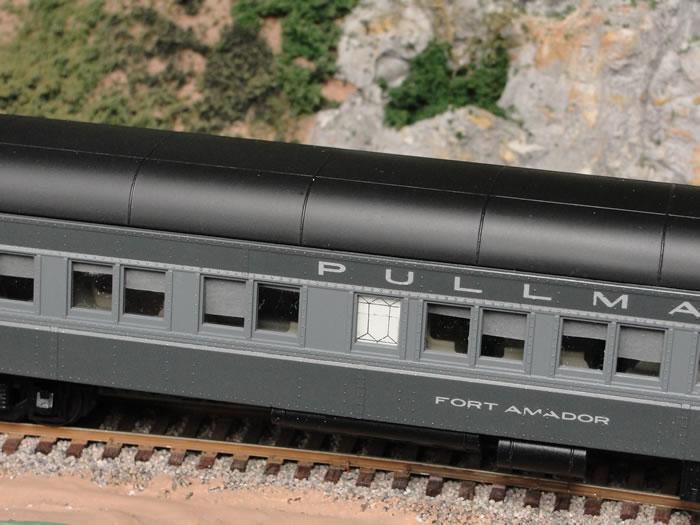
Fig. 8. This view into the windows of lettered car with window glass and shades suggests that I went overboard with shades. When I get the urge I will remove most of the shades to reveal more of the interior detailing.
(Note: If your car is from an early production run, you will have to glue the roof in place when you're done, or else come up with your own method for mechanically securing it so it can be removed in the future.)
I learned a couple of lessons on this project:
- Installing shades everywhere makes the presence of the interior detailing quite subtle, providing only the suggestion that there is something in there.
- Interior detailing is much more obvious without shades and glass.
My recommendations: Glaze the windows. The slight obscuring of the interior is far outweighed by the effect of glass that reflects some light. Install shades but don't go overboard; apply them to only a few windows.
(editorial note: the S Scale SIG web site dated this issue as "2015", but it should have been "2016", which we corrected here)